+86-13901441113


Choosing the best Outdoor Play Slides from China requires more than comparing prices or colorful designs. A reliable evaluation begins with the slide’s structure, materials, safety features, and intended age range. Chinese manufacturers offer many options, from compact daycare slides to large commercial playground systems. Quality can vary, even within the same factory. That matters.
Dr. Donna Thompson, a respected playground safety specialist and former leader of the National Program for Playground Safety, has said, “Supervision is an important part of playground safety.” Her point remains practical. A well-designed slide still needs suitable fall zones, stable platforms, clear access points, and responsible adult oversight. Buyers should request material specifications, load ratings, installation instructions, and independent test documentation. Standards such as EN 1176 or ASTM F1487 may provide useful reference points, but certificates should be checked carefully. A logo alone proves little.
This guide examines Outdoor Play Slides from China through an experience-based lens. We will consider stainless steel and rotomolded plastic surfaces, UV resistance, drainage, weld quality, handrails, and replacement support. Shipping and installation also deserve attention. A beautiful slide can become a poor investment when spare parts are unavailable. That is an uncomfortable detail, but it is real. We may not identify every manufacturing weakness from photographs alone. Therefore, factory communication, sample inspection, and third-party verification should influence the final decision. The strongest choice balances play value, durability, documented safety, and long-term service.
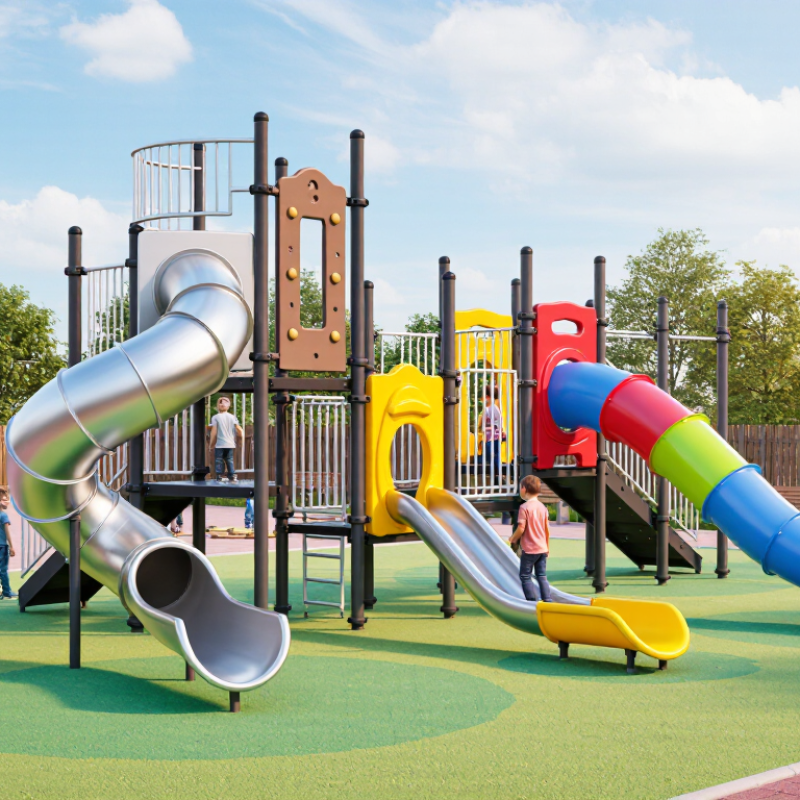
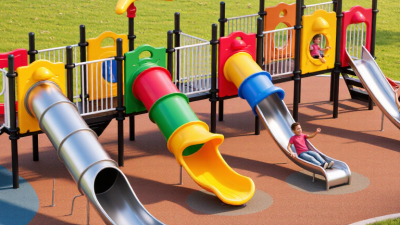
China-made outdoor slides should be classified by function, not appearance alone. A straight slide suits compact parks and clear sightlines. Curved, spiral, and wave designs need more space and stronger side protection. A tunnel model adds shade, but staff must inspect visibility and ventilation. In my site reviews, platform height caused more confusion than slide length. That distinction matters.
Use platform height to create practical age bands. Low slides, around 0.6–0.9 metres, generally fit toddlers with shallow steps and handrails. Medium slides, around 1.0–1.5 metres, suit many preschool users. Taller slides require better balance, longer run-outs, and controlled access. These are planning ranges, not universal rules. EN 1176 and ASTM F1487 address fall height, surfacing, entrapment, and impact risks. They do not replace a site-specific assessment.
The risk is measurable. The U.S. Consumer Product Safety Commission’s Public Playground Safety Handbook reports that falls cause about 79% of playground injuries. It also estimates over 200,000 annual emergency-department visits in the United States. Ask suppliers for platform-height drawings, age recommendations, material specifications, and test documents. Check welds, rounded edges, drainage holes, and surfacing depth. A certificate alone is not enough. I would test a sample after rain; glossy surfaces can become unexpectedly slippery. Age labels may be overly optimistic, so supervision and local standards still decide suitability.
What Are the Best Outdoor Play Slides from China?
A strong outdoor slide starts with verifiable safety evidence, not attractive colors. EN 1176-1:2017 sets general requirements for public playground equipment, including entrapment, sharp edges, structural strength, and impact zones. Slides also require review against EN 1176-2. ASTM F1487-21 adds detailed performance criteria for U.S. public playground equipment. Check platform height, side barriers, exit speed, and load testing. Small details matter.
CPSC data cited in its Public Playground Safety Handbook estimates about 200,000 children receive U.S. emergency treatment for playground injuries each year. Falls remain a major concern. Therefore, a Chinese supplier should provide test reports, material specifications, welding records, and installation instructions. Reports should come from a laboratory accredited to ISO/IEC 17025. CPSC rules and guidance also emphasize protective surfacing beneath and around slides. Concrete is not an acceptable impact surface.
In practice, I would inspect the slide’s entrance and exit by hand. There should be no exposed bolts, pinch points, or rough fiberglass edges. The landing zone needs measured clearance, stable surfacing, and proper drainage. A certificate alone is not enough. Site installation can weaken good equipment. This is where buyers sometimes underestimate risk. I would also request production photos and a pre-shipment inspection. No process is perfect, including this one. A missing measurement or unclear translation may deserve further checking. CPSC Public Playground Safety Handbook; EN 1176-1:2017; ASTM F1487-21.
| Product Profile | Typical Configuration | Recommended User Group | Typical Platform Height | Typical Slide Length | Common Materials | Best Use Case | EN 1176-1:2017 Benchmark | ASTM F1487-21 Benchmark | CPSC Playground Safety Focus | Key Verification Documents | Overall Safety Position |
|---|---|---|---|---|---|---|---|---|---|---|---|
| Low Single Straight Slide | One straight chute with a small access platform and ladder or steps | Approximately 2–5 years, subject to the supplier’s design and risk assessment | 0.60–0.90 m | 1.20–1.80 m | Rotomolded or fiberglass-reinforced plastic chute; galvanized steel or stainless-steel frame | Preschools, compact residential gardens, and small early-years play areas | Check fall zones, entrapment openings, handrails, guardrails, access steps, sharp edges, impact attenuation, and installation stability | Check age-group design, structural integrity, accessible clearances, entrapment prevention, slide exit design, and impact-attenuating surfacing | Use protective surfacing under and around the equipment; maintain the manufacturer’s use zone and inspect for protrusions, pinch points, and damaged hardware | Test reports for the complete assembly, material information, installation manual, maintenance schedule, and surfacing documentation | Strong for younger users when correctly installed |
| Medium Straight Slide | Single straight chute connected to a platform with ladder, steps, or climbing access | Approximately 3–8 years, depending on platform height and access design | 0.90–1.20 m | 1.80–2.70 m | UV-stabilized HDPE or fiberglass-reinforced plastic; powder-coated or galvanized metal supports | Public playgrounds, community recreation areas, and kindergarten play zones | Verify the slide’s starting and exit zones, side barriers, platform protection, fall height, entrapment openings, corrosion resistance, and structural load performance | Verify compliance with public-use playground equipment requirements, including slide geometry, barriers, sharp-point control, fasteners, and structural testing | Provide an appropriate protective surfacing system based on the equipment’s critical fall height; maintain clear use zones and inspection access | Independent laboratory report, drawings with dimensions, critical fall height data, installation records, and routine inspection checklist | Good general-purpose option after site-specific review |
| Wave or Curved Slide | One-piece or sectional chute with a curved or wave-shaped sliding path | Approximately 3–8 years, based on the actual design and access height | 0.90–1.50 m | 2.00–3.50 m | Rotomolded polyethylene, molded plastic, or fiberglass-reinforced plastic with metal supports | Themed playgrounds and medium-sized outdoor play structures | Pay special attention to transition zones, side containment, slide exit velocity, protrusions, finger entrapment, and accessible maintenance points | Assess the complete slide path, sidewalls, transitions, exit section, structural attachment, and use-zone dimensions under the public playground equipment standard | Check for head, neck, clothing, and finger entrapment risks; keep the landing area free from hard obstacles and maintain impact-attenuating surfacing | Dimensional drawings, complete-product test report, attachment details, UV and weathering information, and installation photographs or records | Suitable only when the curved geometry is fully documented |
| Spiral or Tube Slide | Enclosed or partially enclosed spiral chute connected to an elevated platform | Usually 5–12 years, depending on enclosure, height, visibility, and access controls | 1.20–2.10 m | 3.00–5.50 m | Rotomolded polyethylene, molded fiberglass, stainless-steel or galvanized steel supports | Larger public playgrounds and multi-platform play systems | Evaluate visibility, enclosure openings, entrapment hazards, emergency access, sidewall continuity, transitions, fall zones, and the effect of the spiral geometry on user movement | Check enclosed-slide openings, user visibility, structural connections, access barriers, slide exit dimensions, and age-appropriate design requirements | Give particular attention to enclosed-space entrapment, clothing hazards, supervision visibility, fall-height surfacing, and routine inspection of joints and fasteners | Full design drawings, enclosure and opening measurements, structural calculations, third-party test results, installation manual, and maintenance plan | Higher design and inspection burden |
| Stainless-Steel Straight Slide | Open straight chute with metal sidewalls, platform, and metal support structure | Approximately 5–12 years, subject to heat management and design height | 1.20–1.80 m | 2.40–4.00 m | Stainless steel or galvanized steel; non-metal access components may be used for handrails and steps | High-traffic public parks where vandal resistance and long service life are priorities | Verify surface temperature risk, rounded edges, weld quality, corrosion resistance, slide transitions, fall zones, and protection from direct impact with posts or foundations | Check structural performance, accessible edges, fasteners, slide exit design, elevated-platform protection, and the suitability of the metal surface for the climate and installation site | Inspect for excessive heat, sharp edges, protruding hardware, corrosion, and inadequate impact attenuation; consider shade and local climate exposure | Material grade or coating information, weld and structural inspection records, load calculations, installation documentation, and surface-temperature risk assessment | Durable, but climate and heat exposure require verification |
| Dual-Lane Straight Slide | Two parallel chutes sharing one platform and access structure | Approximately 3–8 years, provided both lanes are age-appropriate | 0.90–1.50 m | 1.80–3.50 m per lane | UV-stabilized plastic or fiberglass-reinforced plastic; galvanized or powder-coated steel frame | Schools and public playgrounds that require higher throughput | Check lane separation, side containment, simultaneous-use loads, platform congestion, fall zones, exit clearances, and the potential for collisions between users | Verify structural capacity for concurrent use, spacing between lanes, barriers, access control, slide exits, and the complete use-zone layout | Maintain separate landing and circulation areas where necessary; inspect for collision hazards, pinch points, protrusions, and surfacing wear | Structural calculations for simultaneous use, assembly drawings, complete-system test report, surfacing plan, and installation inspection record | Efficient option when traffic flow is properly planned |
| Water-Resistant Compact Slide | Small outdoor slide designed for residential or low-height recreational use | Approximately 2–5 years, based on the manufacturer’s age and weight limits | 0.45–0.75 m | 0.90–1.50 m | UV-stabilized HDPE or polypropylene; plastic or coated-metal support components | Private gardens, childcare facilities, and low-capacity play areas | Confirm stability, access safety, rounded edges, slide exit clearance, anchoring, material weather resistance, and the applicable equipment classification | ASTM F1487-21 is intended for public playground equipment; if used in a public setting, confirm that the complete assembly—not only the slide—meets the applicable requirements | Follow the applicable CPSC recommendations for protective surfacing, anchoring, supervision, inspection, and age-appropriate use | User instructions, weight and age limits, anchoring details, material safety information, inspection guidance, and evidence of product-specific testing | Appropriate for low-height use with strict user limits |
Choosing outdoor play slides from China requires more than checking shape, price, or colorful finishes. Material evidence matters. A 304 stainless-steel ladder offers strong corrosion resistance, but chloride-rich air can still cause pitting. That risk increases near coasts and swimming pools. Real inspection should examine welds, fasteners, edges, and water-trap areas.
HDPE slide panels also need UV evidence. The Plastics Europe Plastics—The Fast Facts 2024 report recorded 413.8 million tonnes of global plastics production in 2023. That scale shows plastic is widely engineered, but it does not prove outdoor durability. Ask for UV exposure conditions based on ISO 4892-3 or ASTM G154. Request color change, impact strength, and surface cracking results. A bright surface can hide aging underneath.
Salt-spray testing adds useful evidence. ISO 9227 defines neutral salt spray methods, but it does not set universal pass-or-fail service life. Test duration alone can mislead. A supplier should disclose test hours, chamber conditions, specimen preparation, and corrosion grading. ISO 9227 should support, not replace, field judgment. ASTM F1487 and EN 1176 also guide playground safety, including entrapment, impact, and structural hazards. One weakness remains: laboratory samples may be cleaner than real installations. Dust, standing water, harsh sunlight, and poor drainage deserve attention. A certificate is not enough.
Choosing outdoor play slides from China requires more than comparing bright colors and catalog photos. Load capacity should match the intended age group, with extra allowance for active movement. A slide rated for 100 kilograms may not be suitable for several children climbing together. Ask for test reports, material specifications, and clear installation instructions. Verify whether the stated capacity covers the platform, ladder, and sliding lane.
Fall height deserves close attention. A higher platform can create greater injury risk if the surrounding surface is poorly prepared. Measure from the highest standing point to the ground, not from the slide entrance alone. Check the required safety zone around the exit. Footprint also matters. A compact slide may suit a small backyard, but narrow access routes can make installation difficult. Measure gates, stairs, and delivery paths before ordering.
Price comparisons should include shipping, assembly, anchoring, replacement parts, and surface preparation. The cheapest quotation is rarely the complete cost. Warranty terms need equal scrutiny. Confirm coverage periods, excluded damage, response times, and whether spare parts remain available. Written details matter. One weakness in my own early comparison was ignoring maintenance labor, which changed the real budget later. A reliable supplier should provide consistent drawings, traceable materials, and practical answers rather than vague promises. Inspect welds, fasteners, edges, and drainage points before children use the equipment. Small details count.
When sourcing outdoor play slides from China, supplier verification should begin at the factory, not in a product catalog.
I have found that clean photos can hide uneven welding, thin plastic walls, or crowded storage areas. Photos can deceive. Request a recent factory audit with production capacity, worker safety, material controls, and quality records. Check whether the audited factory actually manufactures the slide, rather than trading it.
Ask for test reports linked to the exact model, material, dimensions, and production date. A report for a similar slide is not enough. Review impact resistance, sharp edges, load capacity, UV exposure, and chemical testing. Confirm the laboratory’s identity and report number independently. Certification should match the destination market and the intended age group. Check its validity, scope, and issuing organization. Never accept a certificate image without verification.
Setup evidence matters just as much. Request clear instructions showing anchoring points, ground preparation, fall zones, and recommended tools. For a playground slide, I would inspect bolt coverage, platform height, handrails, and drainage after installation. A supplier should explain surface requirements, such as level soil or impact-absorbing material. I once overlooked drainage details, and standing water later created extra maintenance. That mistake changed my inspection checklist. Ask for assembly videos, replacement-part support, and written responses to every safety question. Vague answers are useful warnings.